


Don Rickles is one of my favourite comedians. He was an insult comic, which sounds like the whole act should be cruelty, but it never was. It was the way he did it. You were in on the joke even while you were the joke. My wife believes she’s the Don Rickles of our household. She says this with no irony whatsoever, apparently because she roasts our dogs. The dogs have not been consulted.
I bring up Rickles because of a book by a dead man, Ernest Becker, called The Denial of Death.¹ You’ll notice most of my favourite thinkers are dead. That turns out to be relevant.
The Contradiction We Have to Forget
Becker’s argument starts with a contradiction every person lives inside all day long. We’re animals. Soft, perishable, decomposing a little more with every step we take through the world, same as every other creature. Except, unlike every other creature, we know it. We know we’re going to be worm food. And in the same breath we can imagine anything: symphonies, physics, the microphone I’m talking into, the entire genius apparatus of civilization. Becker’s phrase for this is perfect: we are gods with anuses.
You can’t hold that contradiction in full view and still function. You’d be wrecked all day. So we build things to forget it with: identity, politics, family, nation, career. Narratives that manage the existential anxiety of knowing that, eventually, you die alone.
Most of the time the narratives are ordinary. Having children is one. It’s not physical immortality, but it’s psychological immortality. Some part of you carries on. But sometimes the narrative is pushed further, from managing the anxiety to beating it. That’s when you get the white nationalist, or someone like Trump. I don’t know why I separate the two. That’s also when you get any project whose real product is the feeling of being above — a supremacy narrative that tells its believers they’re more than human, so they don’t have to be the frightened animal they are. It feels incredible. That’s the problem.
We all build narratives to survive knowing we’ll die. Sometimes the narrative gets out of control, and we call it politics.
The Fantasy of the Godfather
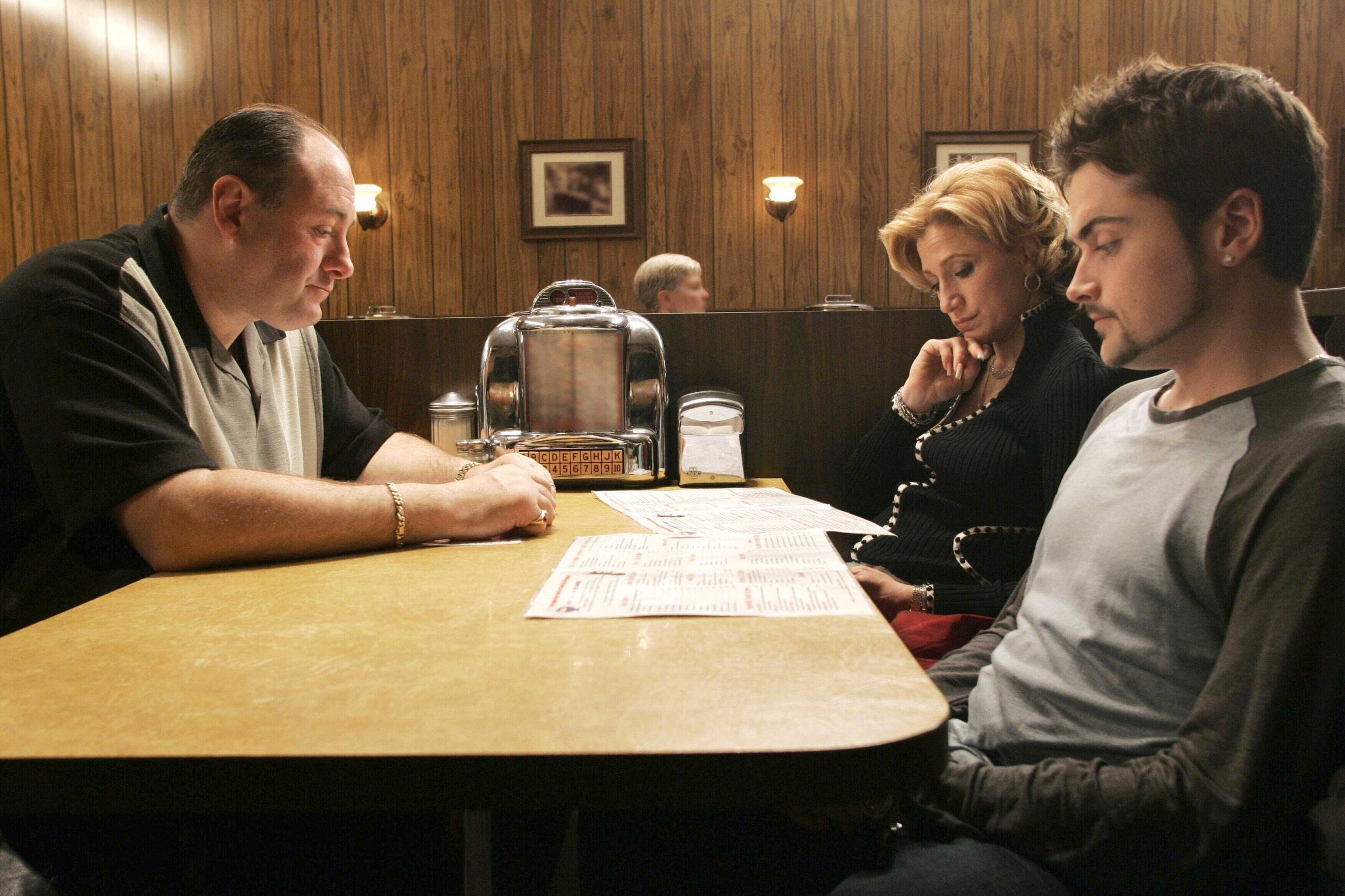
I’ve watched The Sopranos two or three times, and every time I think it’s one of the funniest shows ever made. Only now do I understand why. It’s a show about the denial of death, start to finish.
Tony Soprano is a man falling apart. Panic attacks, therapy, dread. And he’s trying to hold it together inside a world that is fundamentally meaningless: the mob. What the mob has instead of meaning is a fantasy. The code, the honour, the Godfather mythology of respect. And that fantasy can’t survive contact with how these people actually live. They stab each other in the back. They gossip. They’re petty. It’s a high school cafeteria with guns.
Look at the episode where they go to Italy. They arrive completely enamoured with the idea of the mob, the old country, the source. And the real Italian mob laughs at them. The origin they built their identity on turns out to regard them as a costume.
Or the traffic stop. Tony and Carmela get pulled over, the cop goes back to his car to run the licence, and Carmela is indignant: aren’t there real criminals to pull over?
Lady, your husband is a murderer.
That’s the whole show in one line. It keeps staging the contradiction, and the characters keep failing to look at it. They can’t get away from the reality of their lives, so they refuse to see it.
“Aren’t there real criminals to pull over?” Lady, your husband is a murderer.
Born Into the Costume
Here’s where Heidegger² comes in. None of these people chose this world. They were thrown into it. They were born into roles someone else wrote, and they spend their lives trying to fit costumes that were never cut for them, then defining themselves by the fit.
You can watch the mechanism running when Tony finds out that Assemblyman Zellman is seeing Irina, his former mistress. Tony never cared much about her while she was his. Then someone else has her, and he shows up and beats the niceness out of Zellman with a belt. I’ve never used that phrase before, but it’s the correct one. What’s driving Tony isn’t love or jealousy. It’s rank. How can this guy be on my level? I’m more than him. She belongs to me. A person is only an object in someone else’s immortality project.
And then the ending. The cut to black. Everything Tony built — the empire, the family, this monument to himself — just stops. No resolution, no meaning delivered. Worm food. People were furious. Of course they were. The show refused them the denial it spent six seasons dramatizing.
Every Insult Is a Confession
Which brings me back to insult comedy. I watch a lot of it on TikTok and Instagram, and I find most of it boring. Not to insult anyone. Although I guess I just did.
I’ve been insulted a lot in my career. It comes with the job. You say something, someone gets mad, and they insult you. I used to do a bit about how, at the end of the day, we’re all boring. That we’re basically here to reproduce and die. I didn’t know then that I was pulling from Becker, but that was the idea. And more than once, someone in the room who saw himself as important would push back: I’m not boring. And I’d say, yeah, you’re probably the most boring person here. I’ve had people storm out of the show over it.
It was never about me. It was their existential anxiety. I’d just told them that the thing they’d built themselves into was nothing, and that it was going to fall apart.
That’s why insults don’t land on me anymore. An insult is usually just someone telling you their fears. I get called fat a lot. What that actually means is: I’m terrified of being fat, because fat means the out-group, and if I’m in the out-group nobody comes to my funeral, and then I really die. That’s the whole sentence, compressed into one word.
An insult isn’t an attack. It’s a confession of what the other person is afraid of.
Men usually go for money. What do you drive? I make more than you. They assume stand-up doesn’t pay, which, fair. Women have come at me with no one will ever love you and you’ll never get married. One woman once told me I don’t have a space between my legs. I said, yeah, because I have testicles.
You’re confessing. Take it from me: don’t go after the comedian unless you’re prepared to expose yourself.
As for the car: yes, I drive a 2010 Pontiac Vibe. It is not a great car. It does have a regular plug in it, which means you could plug in a smoke machine, pull up to a bus stop and pretend you’re Doc Brown. Marty, get in. It’s a bad car. But here’s what you don’t understand when you mock it: I bought that car with jokes. Do you know how hard it is to buy something with jokes?
I drive a 2010 Pontiac Vibe. I bought it with jokes. Do you know how hard it is to buy something with jokes?
AI Will Never Eat at a Wake
Death anxiety is normal. And once you see it, it explains a lot. The panic over AI, for instance. I don’t know how much people actually believe the hype, but the fear makes sense through Becker. We’ve been taught by decades of media that this is the thing that replaces us. It outlives us. It can’t die.
Which I’d call the downside of AI, honestly. Think about everything it misses by not dying. Have you ever had one of those little sandwiches at a wake? AI will never have one of those. Not the egg salad. The good ones. The food at a wake is incredible. I don’t know if it’s good because someone died or if it’s just good food. I don’t ask. I just eat.
Put the Sopranos, the insult comics and the AI panic together and it’s the same thread. Everyone is trying to be relevant, to be remembered, to count. And we’re doing it inside capitalism, a system that pumps production and value into your head every waking hour, so that your worth and your output become the same number. With that on top of the anxiety of being a god with an anus, no wonder mental health is collapsing at scale.
The left usually says it’s about the means of production, about material conditions, and it is. But the existential layer doesn’t disappear because the material one is real. Both have to be addressed at once. The system runs on our fear of death, and the fear of death runs through the system.
I know this from the inside. I used to be terrified that nobody would show up to my funeral. What would people say? What would it look like? I held on to toxic relationships for years, basically because I needed pallbearers. Somebody had to carry the casket.
So I told my therapist about it. The fear. The empty chapel. Looking like a loser.
She said: why would you care? You’ll be dead.
So simple. I’d built a whole life around my own funeral’s attendance numbers, and she took it apart with one question.
Footnotes
¹ Ernest Becker, The Denial of Death (1973). Becker argues that human culture is largely a system of “immortality projects”: symbolic hero systems that let us avoid confronting our mortality. He names the human condition through the image of creatures who are half symbolic, half animal, “gods with anuses.”
² Martin Heidegger, Being and Time (1927). Heidegger’s concept of thrownness (Geworfenheit): we find ourselves already cast into a world, history and set of roles we did not choose, and we make ourselves out of what we were thrown into.