


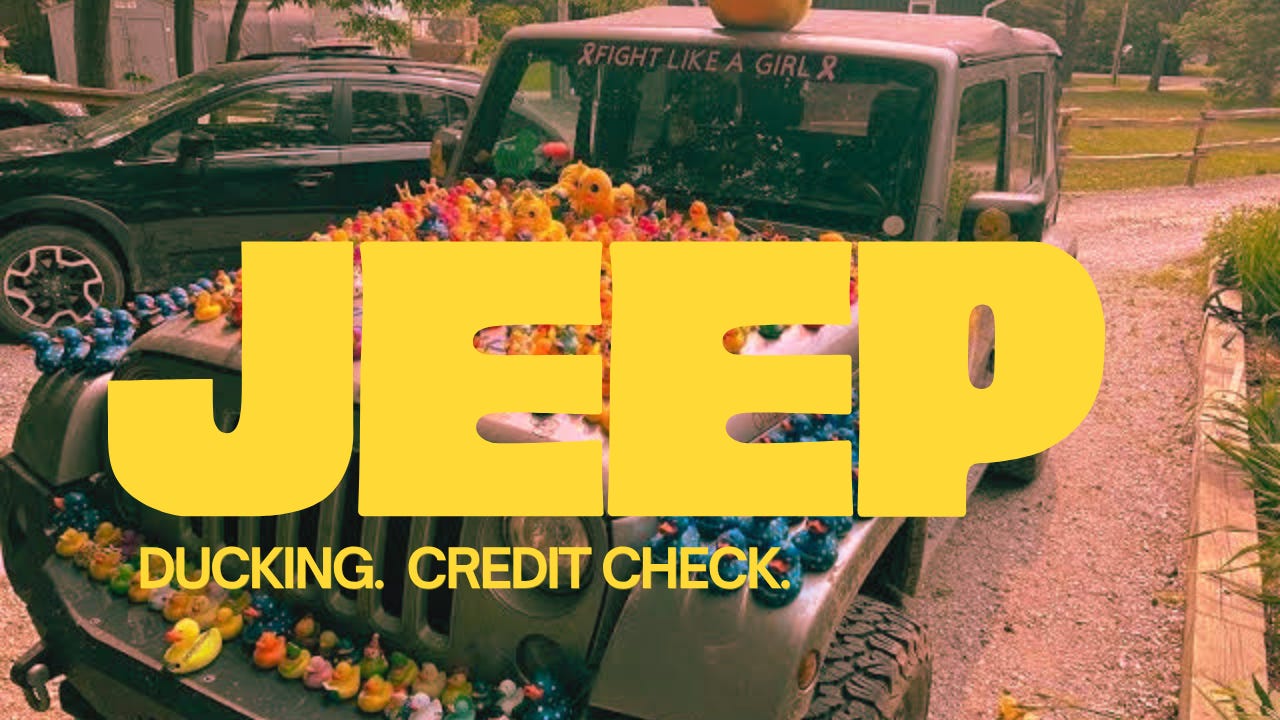
Jeep ducking is a phenomenon I recently found out about, where Jeep owners place rubber ducks on a stranger’s dashboard. It’s a wave, a handshake, a badge of membership to a club. I think it started pretty innocently — a woman wanted to brighten a stranger’s day while we were all locked down under COVID restrictions. A way to put a smile on the face of someone you didn’t know.
And I fucking hate it.
The Gesture That Isn’t For Everyone
Rightfully, my wife points out my wet-blanketness on this whole subject: people just want to put a smile on a stranger’s face during a difficult time in our history. The goal isn’t to be a clandestine, moustache-twirling baddie while placing ducks on Jeeps. The sincerity is real. I don’t doubt that sincerity for a minute.
But sincerity isn’t my problem.
The duck is exclusive. It’s a gesture extended from Jeep owners to Jeep owners, for the ability to do what? Own a Jeep. And this becomes more obvious when you see a pickup truck with ducks on the dash. It’s weird. Off, even. Even people inside this “nice gesture” can feel it. Oh, that’s wrong. Goddamn pickup truck, doesn’t know its place!
Sure the kindness is real, but it’s also the proof of purchase.
A Jeep is not cheap. You don’t need to be rich to own one, but if you want to sleep soundly at night without fear of the bank taking it away, you need to be solvent in a specific, brand-legible way — or know someone whose solvency you can borrow. So the rubber duck kindness is really just a credit check. What looks like a community of nice people is really a gated community on wheels.
Crash, or: What Happens When the Product Loves You Back
I recently read Crash, J.G. Ballard’s novel¹ — not the Cronenberg film I half-remember disturbing me as a teenager, but the book that gave him the material. A man survives a serious accident and falls in with a former television scientist obsessed with dying in a car crash engineered for maximum sexual intensity, ideally involving Elizabeth Taylor.
Yes, that Elizabeth Taylor.
The book is, at first, simply gross — car-on-body prose written like Danielle Steel had taken over as editor of Car and Driver. I nearly put it down more than once. But the accumulation is the point. By the time you get to the chapter where a man is sitting in traffic covered in the evidence of the last several hours of automotive baby-making, the grotesque has curdled into something else: comedy, and underneath the comedy, a diagnosis. Crash is a meditation on where the human being ends and the product begins, once the product has been fully eroticized — once celebrity, technology, and the self have been fused into a single being of consumption with no outside left to stand on.
Ballard’s characters don’t own their cars. They’re in a friends-with-benefits relationship with them.
The duck is a smaller, much cleaner, PG version of the same collapse.
The Hoodwink
This is Marx’s territory, and he has a name for it: commodity fetishism². The claim isn’t that people are foolish for loving objects. It’s that the object is seen as pre-loaded with a kind of magic — the Jordans that let you jump, the Jeep that makes you kind — and the magic works precisely by hiding the labor, the supply chain, the hand that built the thing. You don’t see the factory, the hairnets, or the lunchroom. You see the feeling.
And this is the part that actually works: you don’t just admire the product. You relate to it as a piece of yourself. An identity that extends outward from you, seamlessly, so that defending the brand starts to feel like defending your own character. Once that happens, the transaction is over, and there you are, doing the enforcement yourself, at the level of “naturalness,” mistaking a purchase for a personality.
We have become the product, in more ways than one.
Social media didn’t invent this. It just stopped being subtle about it. You walk into a grocery store believing your complimentary points card will help you buy food. But the product isn’t food — the product is your data. The food is the loss-leader that gets you in the door, so the store can sell the data collected by the card you graciously gave up for points.
It’s the ole hoodwink: the visible product is never the real business. This is, more or less, how Ford made its money too — not primarily by building cars, but by financing them. The car was the pretext. The loan was the business.
Which is also why the online complaint “don’t they make enough already?”, aimed at influencers who ask their audience to cover a bill, always lands slightly off target. It’s not the wrong instinct, just aimed at the only visible layer of the transaction. The harder question — how does the free platform actually make its money, and off of whom — stays comfortably out of frame, which is exactly where it needs to stay for the system to keep running.
Wet Blanket, Personally Speaking
By the time I’d worked all of this out loud, my wife is silent, eyes closed, headed toward a full night’s sleep. I don’t blame her. I’ve just spent several hundred words explaining why a plastic toy on a dashboard is a load-bearing piece of ideology, when really, if the duck could speak, it would probably say: Dude, it’s just for fun.
And that, my friends, is why I don’t get invited to parties.
Footnotes
¹ J.G. Ballard, Crash (1973). Ballard’s novel follows a man drawn into a subculture that eroticizes car-crash trauma, using the collision of body and machine to stage a broader collapse between technology, celebrity, and desire.
² Karl Marx, Capital, Vol. 1. Marx’s term for the way commodities appear to carry inherent, almost magical value — obscuring the human labour that actually produced them, so a relationship between people gets misread as a relationship between things.