


My wife sent me an Old Navy Malcolm X shirt. The joke is immediate and exhausting: here is one of the 20th century’s most uncompromising figures, flattened into a garment made for $3 and sold at a mall. Here is the system saying: yes, sure, wear your rebellion. Do it. Make it into a product.
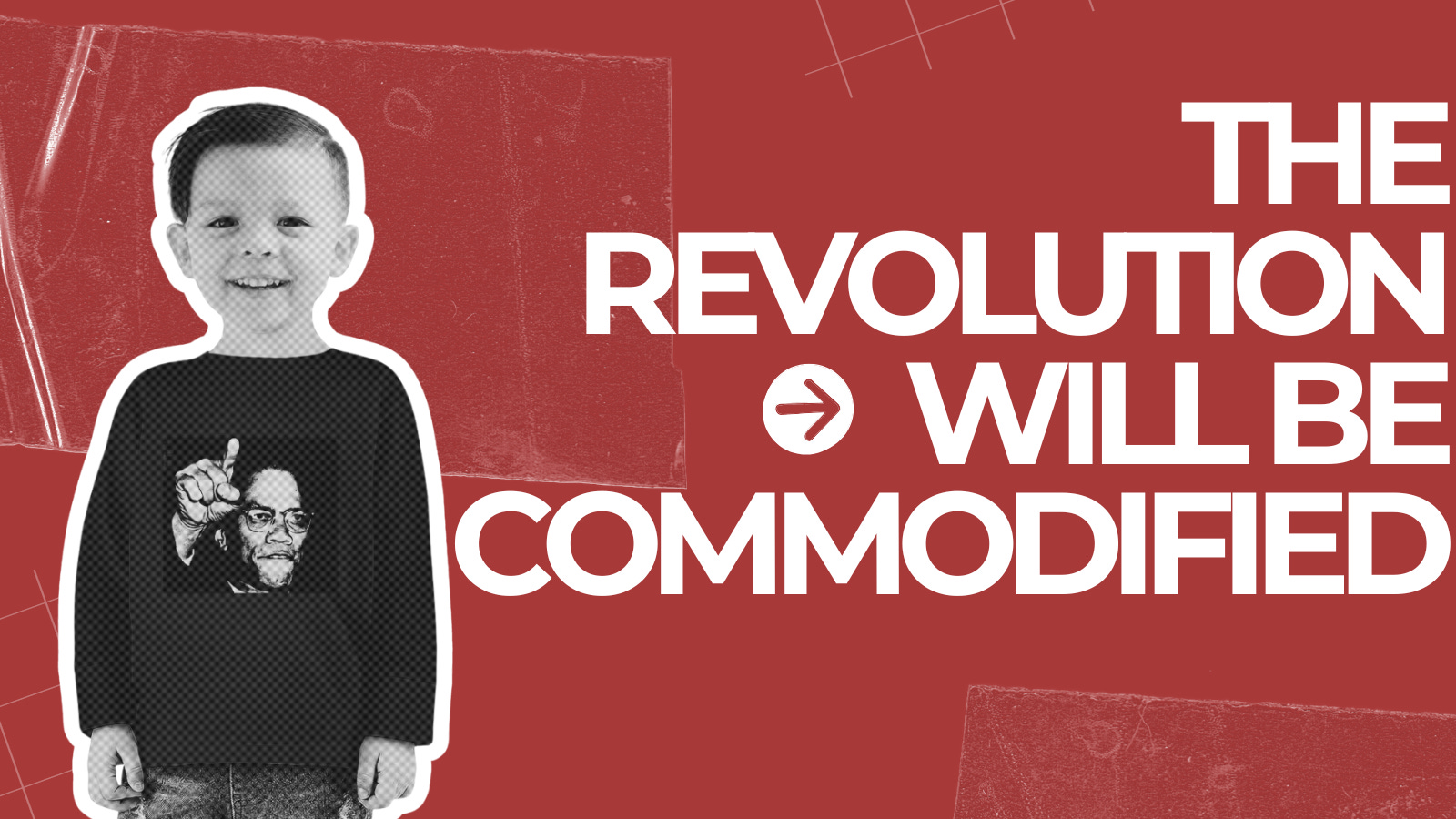
This is not an accident. This is the mechanism.
Mark Fisher¹ calls this capitalist realism — the condition in which it has become easier to imagine the end of the world than to imagine the end of capitalism. But it’s not just about belief. It’s about structure. It’s about how the system doesn’t need to defeat your resistance; it needs to absorb it. And once it does, resistance becomes another commodity, another market segment, another thing to buy.
The Malcolm X shirt is the object that makes this visible.
Everything Revolutionary Gets Bought
The problem isn’t that Malcolm X appears on a t-shirt. The problem is that once he does, everyone knows what it means to wear him. The meaning has already been decided. The revolutionary has been translated into a sign—and signs don’t threaten systems; they service them.
This happened to Frida Kahlo. To Martin Luther King Jr. To Rosa Parks, except worse: during COVID lockdowns, people compared themselves to Rosa Parks because they couldn’t get their hair dyed. The pain and entitlement became so real, the comparison so casual, that it erased the entire historical weight. Rosa Parks didn’t become more powerful on a protest sign; she became smaller, compressed into a motivational poster, drained of the specificity that made her dangerous.
This is what capitalism does to revolution. It takes the threat and leaves the image.
The Spectacle Knows No Enemy
Watch what happened to the January 6th Capitol riot. People stormed the building, climbed over things, were shot at—and then they didn’t know what to do. They walked around taking selfies. They stole things. It became a carnival, a festival, a mall where the merchandise was democracy itself.
The same thing happened to the Canadian trucker convoy. A month-long occupation that looked, from the outside, like actual disruption—until you watched it fold into a street festival. People bragging about what a great time it was. A George A. Romero² Dawn of the Dead scenario: zombies instinctually walking into a mall, except these zombies were protesting wearing F-Trudeau merchandise they’d bought specifically to broadcast their anger.
What frustrated me wasn’t even that I disagreed with these people politically. It was watching them not see the trap. Their protest was already sold to them. Their resistance was pre-packaged. F-Trudeau on a t-shirt, MAGA hats, Make America Great Again merchandise—it’s not just slogans. It’s the proof that even your anger is a market. Even your rage can be monetized and sold back to you.
As Audre Lorde said: you’re using the master’s tools to fight the master³. Except the master got there first and decided what those tools cost.
Your protest is in the system. And you’re upset about the system.
The mechanism is elegant: it lets you feel like you’re fighting. It sells you the feeling of agency while keeping you exactly where you started. Locked in.
The Invisible Recycling Loop
This is where personal consumption activism enters the picture. Recycling. The yellow bin in Hamilton. Every environmental program that asks you to sort your garbage, to make the individual choice, to feel like you’re solving climate collapse by putting your pizza box in the correct container.
It’s a conspiracy theory for liberals. And it works perfectly because it feels like action while changing nothing.
Ninety percent of global pollution comes from nine or ten corporations. Not from you. Not from your cans and your sorted compost. But the system needs you to think it does. Because if you believe you can save the planet through consumption choices, you’ll never ask why the planet-destroying companies aren’t regulated or dismantled. You’ll never organize. You’ll just keep sorting.
You’re the baby in the backseat of the car with the tiny steering wheel. You think you’re driving. The wheel isn’t even attached.
Hamilton’s gold-bin program makes this perfect: if you recycle well enough, the city will audit your garbage and award you a gold bin so you can brag to your neighbors about being the best recycler in the world. Meanwhile, there are factories down the street pumping toxins into the air. But look at your gold bin. Look at your individual virtue. Look at the yellow bin, not the eye of Sauron above your head.
The system doesn’t need you to fix it. It needs you to feel responsible for things you can’t control, so you never ask who can.
The Collapse of Revolutionary Meaning
What really got me was watching this happen in real time, across every arena. Politics became ESPN—red team versus blue team, aesthetic versus aesthetic, people buying their colors like sports fans and calling it political engagement. The same mechanism that flattened Malcolm X into a symbol flattened every actual difference into a brand.
We’re told these are choices. We’re told this is freedom. We’re told if you just buy the right thing, wear the right shirt, recycle correctly, vote correctly, you’ll move the needle. You’ll matter. The system will bend.
It won’t. It can’t. Because the system doesn’t exist in spite of your resistance; it exists through your resistance. Every act of rebellion you’re allowed to take is already priced in. Already commodified. Already known.
This is what Mark Fisher means by capitalist realism. Not that capitalism is working. But that we can no longer even imagine an alternative existing. All paths lead back to the mall. All rebellions get bought. All meaning gets flattened into signs that look revolutionary but function as products.
We’re running a wheel. Trying to get a piece of cheese. Chasing narratives that mean nothing—printed on a t-shirt, posted in a bio, recycled into a gold bin—and calling it forward motion.
The Malcolm X shirt isn’t funny because it’s ironic. It’s funny because it’s true. And it’s true every time we try to resist. Every time we think we’ve found a way out. The system doesn’t need to defeat us. It just needs to give us something to buy.
Footnotes
¹ Mark Fisher, Capitalist Realism: Is There No Alternative? Fisher argues that contemporary capitalism has achieved a kind of ideological totality—not through overt propaganda, but through the foreclosure of the ability to imagine alternatives. The famous formulation: “It is easier to imagine an end to the world than to imagine an end to capitalism.”
² George A. Romero, Dawn of the Dead. Romero’s 1978 film uses a shopping mall as both setting and metaphor for consumer capitalism. Zombies instinctively migrate to the mall because it was central to their social existence in life; they continue its logic even in death. The film suggests capitalism persists not through force but through absorption into the logic of desire itself.
³ Audre Lorde, “The Master’s Tools Will Never Dismantle the Master’s House.” Lorde’s argument that resistance movements that use the existing system’s frameworks for critique will only ever reproduce that system’s logic. True transformation requires new epistemologies, not just new slogans.